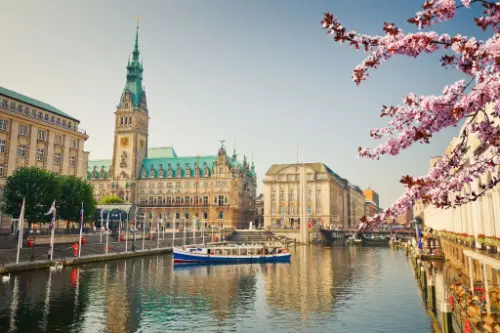
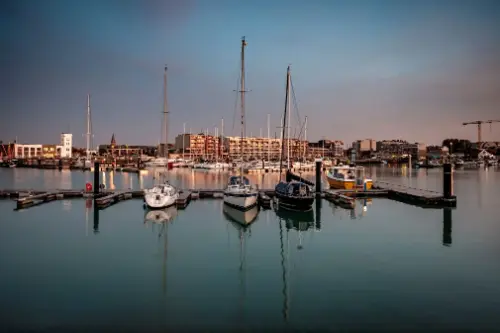
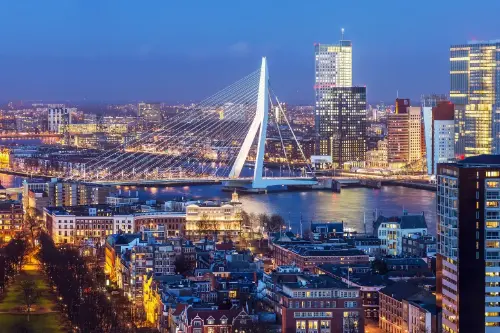
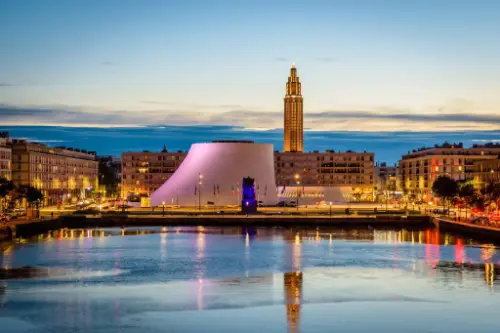
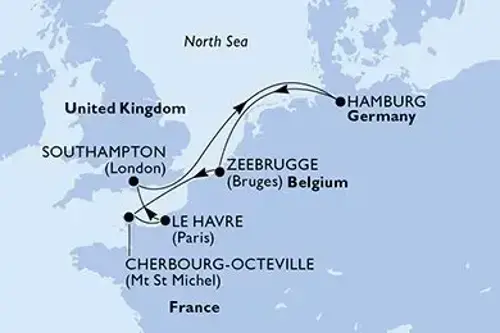
Northern Europe is the third-largest cruise destination on the center.cruises platform, with 1,348 ocean cruises listed for the 2026–2027 season. It is a fast-growing segment: demand for Norwegian Fjord and Iceland itineraries is rising 15–20 % year on year. The region splits into four sub-regions with distinct geography and pricing: Norwegian Fjords (from €499 for 7 nights), Baltic and Nordic Countries (from €599), Iceland (from €700) and the British Isles (from €1,300). The main lines are MSC Cruises (regional flagship MSC Euribia, an LNG-powered ship built in 2023), Costa Cruises, Norwegian Cruise Line, Holland America Line and Royal Caribbean. The season is short — May to September — so July and August require booking five to six months in advance, especially for cabins for three or four people.
Four sub-regions of Northern Europe: where the cruises sail
Northern Europe is not a uniform cruise destination. The four sub-regions differ in itinerary length, type of sights, price and departure-port logistics.
Norwegian Fjords
The most popular sub-region. The key fjords called at are Geirangerfjord (a UNESCO World Heritage Site), Sognefjord (Europe's longest, 205 km), Hardangerfjord and Nordfjord. Main ports of call: Bergen, Stavanger, Ålesund, Flåm, Hellesylt, Nordfjordeid, Måløy. Itineraries run 7 to 12 nights. Entry-level price: €499 for 7 nights on Hamburg — Stavanger — Flåm — Nordfjordeid — Vik — Hamburg. The regional flagship is MSC Euribia, a 2023-built LNG-powered ship operating weekly cruises out of Copenhagen and Kiel with calls at Hellesylt, Geiranger, Ålesund and Flåm.
Baltic and Nordic Countries
A classic cruise along the capitals of the Baltic Sea, offering four Scandinavian and Baltic capitals on a single itinerary. Main ports of call: Copenhagen (Denmark), Stockholm (Sweden), Helsinki and Turku (Finland), Tallinn (Estonia), Riga (Latvia), Gdańsk and Gdynia (Poland), Visby (Gotland, Sweden), Warnemünde/Berlin and Kiel (Germany). Length: 7–10 nights. Entry-level price: €599 for Warnemünde — Gdynia — Visby — Riga — Stockholm — Copenhagen. Extended 10-night itineraries calling at Helsinki and Tallinn — from €800 (Helsinki — Tallinn — Stockholm — Riga — Warnemünde — Kiel — Copenhagen).
Iceland
The fastest-growing sub-segment. Main ports of call: Reykjavík, Ísafjörður (the Westfjords), Akureyri (north Iceland), Seyðisfjörður (east). Often combined with calls in Scotland (Invergordon, Queensferry) and Norway (Måløy, Leirvik). Length: 10–14 nights. Entry-level price: €700 for Reykjavík — Ísafjörður — Akureyri — Måløy — Leirvik — Invergordon — Queensferry — Southampton. Holland America Line, Princess Cruises and Celebrity Cruises are particularly strong on this sub-region.
British Isles
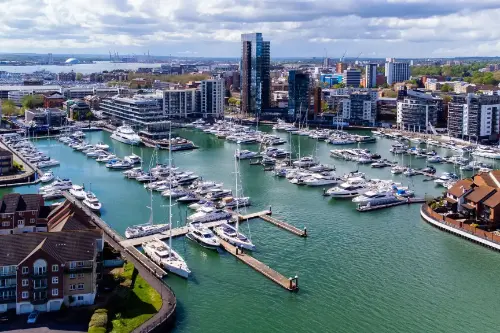
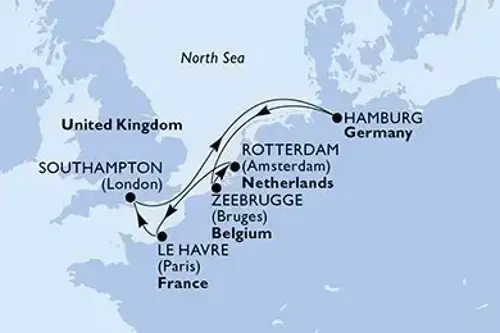
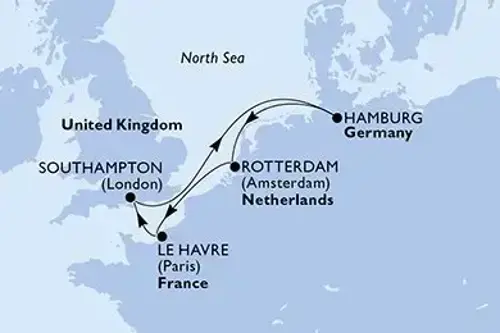
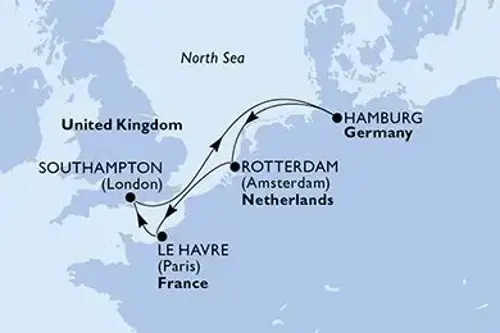
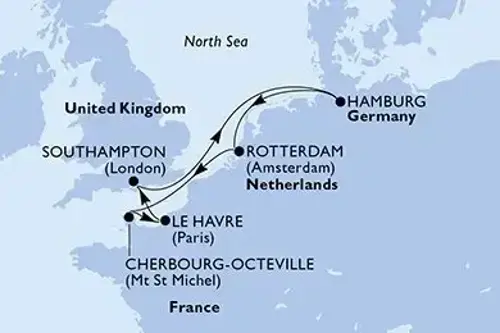
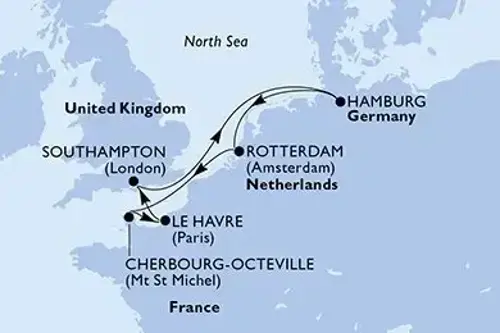
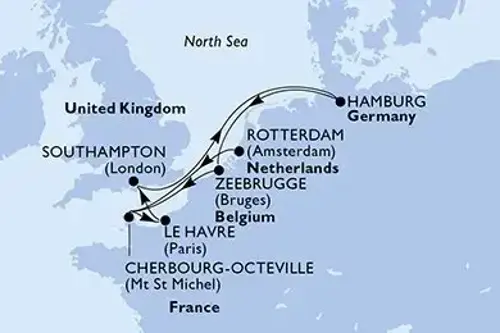
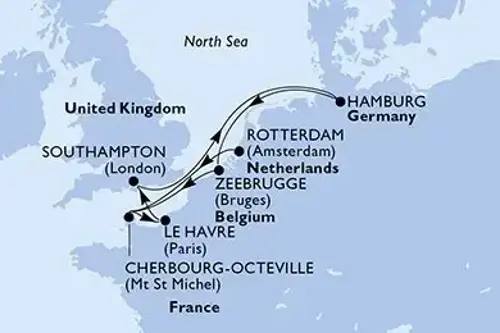
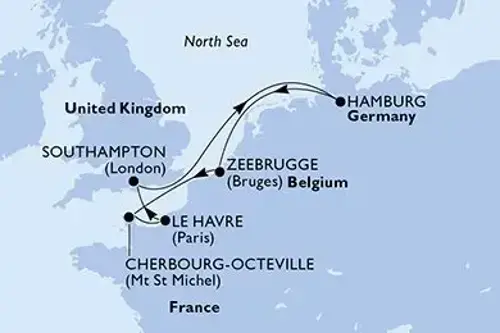
Itineraries with deeper exploration of the United Kingdom and Ireland. Main ports of call: Southampton (London), Greenock (Glasgow, Scotland), Invergordon (Scottish Highlands and Cawdor Castle), Kirkwall (Orkney Islands), Belfast (Northern Ireland), Dún Laoghaire and Cobh (Ireland), Saint Peter Port (Guernsey). Length: 7–14 nights. Entry-level price: €1,300 for Hamburg — Cobh — Dún Laoghaire — Belfast — Greenock — Kirkwall — Invergordon — Hamburg. Important: Ukrainian citizens need a separate UK Standard Visitor Visa, distinct from the Schengen visa.
Main departure ports for Northern Europe cruises
Most Northern Europe cruises depart from German, Danish and Dutch ports. Three key hubs cover the bulk of the schedule.
- Hamburg (Germany) — the most common departure point for Norwegian Fjord and British Isles itineraries. Terminals HafenCity, Steinwerder and Altona. Hamburg Airport (HAM) handles direct flights from Lviv, Warsaw and Tel Aviv.
- Copenhagen (Denmark) — the home port of MSC Euribia and other weekly fjord cruises. Terminals Oceankaj and Langelinie. Copenhagen Airport (CPH) offers direct flights from Kyiv, Lviv, Warsaw, Tel Aviv and Chișinău.
- Amsterdam (the Netherlands) — a port for Norwegian Fjord and British Isles itineraries, particularly with Holland America Line. Passenger Terminal Amsterdam (PTA). Schiphol Airport (AMS) is the largest hub in Northern Europe.
- Other departure ports — Kiel (Germany, weekly fjord cruises), Warnemünde/Berlin (Germany, Baltic itineraries), Southampton (UK, visa required), Stockholm (Sweden), Helsinki (Finland).
Cruise lines in Northern Europe: from MSC Euribia to Viking Ocean
The catalogue lists almost every major cruise company, across three segments: mass-market, premium and luxury.
Mass-market (60–70 % of cruises in the region):
- MSC Cruises — regional flagship MSC Euribia (2023, LNG, 177,100 GT, up to 6,334 passengers). Also MSC Preziosa, MSC Poesia and MSC Magnifica. Core itineraries: 7-night cruises from Copenhagen and Kiel into the fjords, and Baltic loops from Warnemünde. Pricing from €499.
- Costa Cruises — Costa Diadema and Costa Favolosa. Family-oriented Italian mass-market with an emphasis on gastronomy and the on-board Piazza format.
- Norwegian Cruise Line (NCL) — the Freestyle Cruising concept, with no fixed dining time or dress code. Baltic and fjord itineraries.
Premium:
- Holland America Line — the oldest active cruise line (founded 1873), with a long focus on Northern Europe and Alaska. Particularly strong on Iceland and British Isles itineraries.
- Celebrity Cruises — premium design, above-average cuisine, a quieter audience. Fjord and Baltic itineraries.
- Royal Caribbean International — Quantum-class and Anthem of the Seas mega-ships, with fjord itineraries from Southampton.
- Princess Cruises — British-flavoured premium, focused on longer itineraries and the British Isles.
Luxury:
- Viking Ocean Cruises — an adults-only concept with Scandinavian design, focused on cultural programmes around Norway, the Baltic and Iceland. The base fare is closer to all-inclusive, with included drinks and one shore excursion at every port.
Seasonality: why Northern Europe is a summer-only destination
The defining feature of the region is a narrow seasonal window of May to September — which cannot be extended due to daylight hours, water temperature and navigation conditions.
- High season (July–August) — sea 14–18 °C, air 18–22 °C, the polar day above the Arctic Circle (the sun does not set). Prices roughly 30–40 % above average. The main window for families with children during the school holidays.
- Mid-season (May, June, September) — temperatures of 10–18 °C, more moderate prices, fewer tourists at the ports. Ideal for active fjord programmes and photo expeditions.
- Low season (October–April) — most lines redeploy their ships to the Caribbean, the UAE or the Persian Gulf. Only one or two options remain on the platform, calling at the United Kingdom, which requires a visa.
- The Northern Lights are a winter phenomenon from November to March and are NOT available on standard summer Northern Europe cruises. Hurtigruten and Havila operate dedicated expedition winter cruises — a separate segment not listed on the platform.
The booking rule of thumb: for July and August, book at least five to six months ahead, particularly for three- or four-person cabins, MSC Yacht Club and suites. For May, June and September, two to three months is usually enough. Demand outstrips supply, particularly on the popular MSC Euribia and Costa Diadema.
Northern Europe cruise prices: from €499 to €5,000
Prices reflect the 2026–2027 season and depend on the sub-region, itinerary length, cabin category, time of year and cruise line.
| Sub-region | Inside cabin | Balcony cabin | MSC Yacht Club / Suite |
|---|
| Norwegian Fjords (7 nights) | from €499 | from €850 | from €2,500 |
| Baltic and Nordic (7–10 nights) | from €599 | from €950 | from €2,800 |
| Iceland (10–14 nights) | from €700 | from €1,400 | from €4,200 |
| British Isles (7–14 nights) | from €1,300 | from €1,900 | from €5,000 |
Prices are per person based on double occupancy (DBL). The base fare includes the cabin, full board, onboard entertainment, pools and the fitness centre. Not included: port charges (€150–300 for longer itineraries), the service charge (€10–15 per day), alcohol, shore excursions, speciality restaurants and the spa.
MSC Euribia: a new LNG-powered ship for Northern Europe
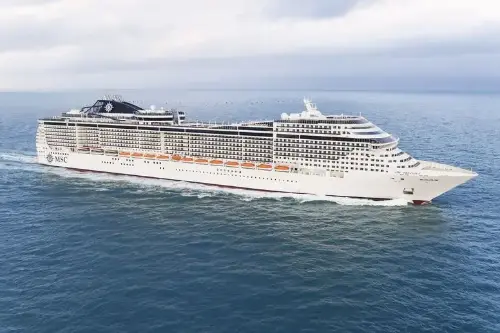
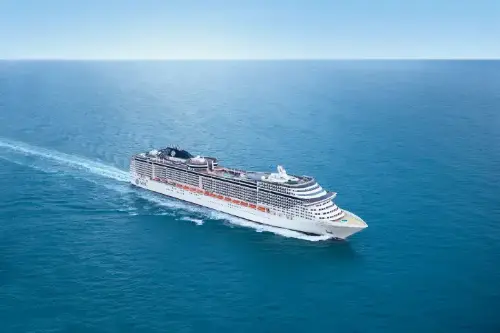
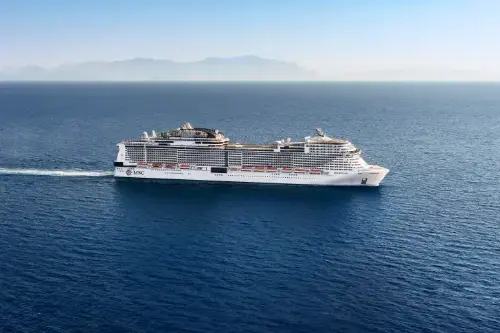
MSC Euribia is the regional flagship and the only LNG-powered MSC ship based in Northern Europe. She entered service in June 2023 and belongs to the Meraviglia Plus class. Her hull is painted in an eco-themed mural by German graphic designer Alex Flämig, as a statement on protecting marine ecosystems.
- Specifications — 177,100 GT, length 331 m, beam 43 m, 19 decks, 2,419 cabins, capacity of up to 6,334 passengers.
- Propulsion — four dual-fuel engines running on liquefied natural gas (LNG) and marine gas oil. Emissions reduced by up to 90 %, complying with IMO Tier III, with shore-power connection capability.
- 2026 itineraries — weekly cruises from Copenhagen and Kiel calling at Hellesylt, Geiranger, Ålesund and Flåm.
- Onboard — LEGO zones for children, the MSC Aurea Spa thermal area, a covered promenade with an LED dome and shops, a 19-piece live band in the Carousel Lounge, and Meraviglia Plus-class theatre shows.
- Cabins — categories from Bella (inside) to the MSC Yacht Club Royal Suite. Yacht Club operates as a ship-within-a-ship: private lounge, dedicated restaurant, personal butler, and priority boarding and disembarkation.
UK visa: what to know before the cruise
If the itinerary calls at UK ports (Southampton, Greenock, Belfast, Invergordon, Kirkwall, Saint Peter Port, Dover), Ukrainian citizens need a separate UK Standard Visitor Visa. A Schengen visa does NOT cover the UK. Applications go through the TLScontact visa centre or the online application at gov.uk; processing typically takes three to six weeks.
Israeli citizens do not need a UK visa, but since 2025 they need a UK Electronic Travel Authorisation (ETA), an online permit issued within 24 hours and valid for two years. Citizens of Poland, Germany, Finland and Sweden also use the UK ETA rather than a visa. We recommend checking current requirements at the time of booking, since the rules change.
Who a Northern Europe cruise suits
- Experienced cruisers — Northern Europe is widely considered a "second step" in a cruising career, after the Mediterranean: more days at sea, longer itineraries, higher demands on weather and clothing.
- Families with children aged 8 and over — MSC Euribia offers LEGO zones, water-slide pools, the MSC Kids Club for ages 3–11 and the MSC Teens Club for 12–17. Under the MSC Kids Sail Free promotion, children under 18 can travel free in a cabin shared with two adults.
- Couples and romantics — the Norwegian Fjords, particularly Geiranger and Sognefjord, are considered among the most romantic cruise itineraries in the world. A natural choice for honeymoons and anniversaries.
- Photographers and nature enthusiasts — the polar day in June and July provides nearly 24-hour light for landscape photography. Iceland and northern Norway itineraries (Måløy, Leirvik) offer the strongest material.
- History and culture enthusiasts — a Baltic cruise covers four capitals (Stockholm, Helsinki, Tallinn, Copenhagen) and three regions (Scandinavia, the Baltic states, the northern coast of Germany) on a single itinerary.
Conclusion
Northern Europe is the third-largest region on the center.cruises platform, with 1,348 cruises for the 2026–2027 season. It is a rational choice for experienced cruisers looking for the next region after the Mediterranean, for families with children during the school holidays, and for couples planning a romantic fjord itinerary. The main piece of advice: for July and August, book five to six months in advance. To narrow the selection, use the filters by sub-region, length, ship and departure port.