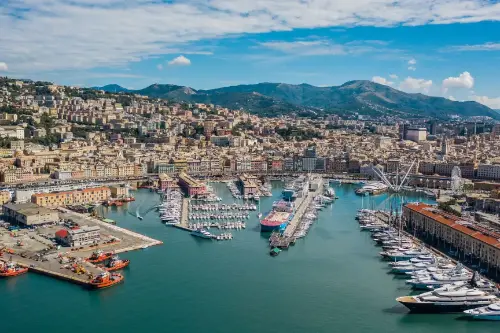
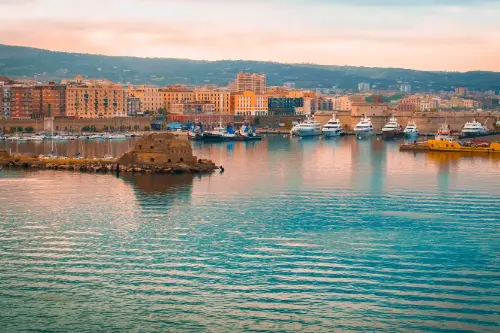
The first thing to understand about this port: it is called Rome, but the ship does not lie in Rome. Civitavecchia is some 70–80 kilometres from the city centre, and the port day has to be counted with the journey included. The good news is that there is usually enough time: eight hours including travel is enough for a first encounter with Rome.
The arithmetic of the port day
The distance from the port to central Rome is about 70–80 kilometres. Depending on the type of train the journey takes roughly 40–90 minutes each way, plus the time from the station to wherever you are heading in the city. This is the arithmetic to keep in mind when planning the day.
| Leg | How long it takes |
|---|
| Port to central Rome | about 70–80 km |
| Train, one way | roughly 40–90 minutes, depending on the train |
| Station to a specific sight | additional time, depending on the route |
| Ship-organised excursion | about 8 hours including travel |
What you can realistically see
A standard 8–10-hour call is enough for the principal sights but not for all of Rome. For a first encounter that is sufficient: the main points plus time for a walk. Trying to cover the whole city in one day is the commonest reason the day disappoints.
How to travel: excursion, train or transfer
The choice depends on your experience and on how much attention you are willing to spend on logistics.
| Option | Who it suits |
|---|
| A ship-organised excursion | A first visit to Rome: enough time for the main sights and for free time, and — crucially — the ship’s excursion always returns on schedule |
| Train and an independent walk | Experienced travellers who know the city and can budget time |
| Private transfer | Those who want their own programme and are ready to plan the journey themselves |
Three mistakes worth avoiding
The first is trying to see too much. The second is ignoring the queues at the Vatican and the Colosseum: they can swallow half the day. The third, and the most expensive, is cutting the return to the port too fine. You cannot be late for a cruise: the ship will not wait. That is exactly why an organised excursion removes the day’s main risk — it is guaranteed to be back before departure.
Itineraries and lines
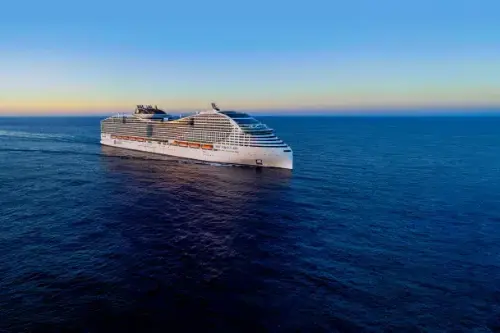
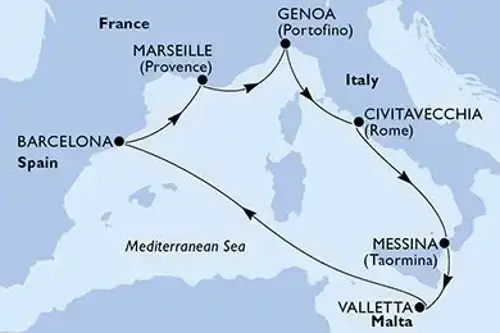
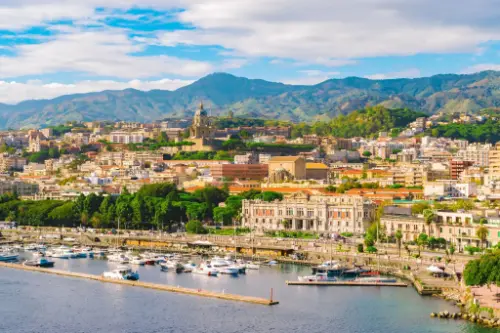
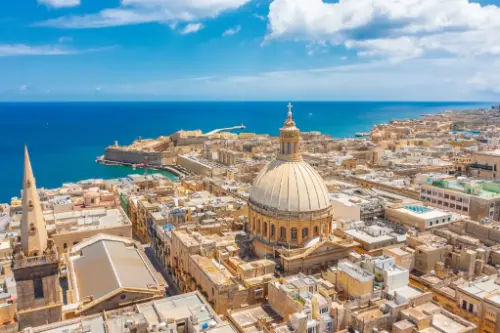
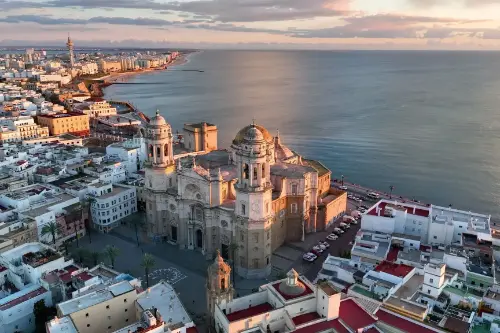
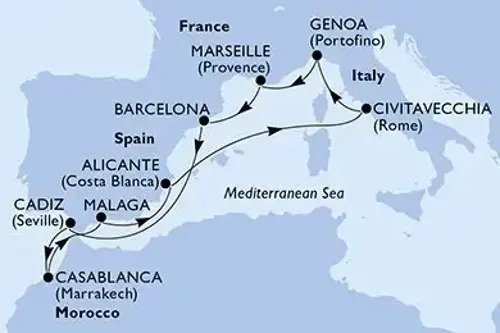
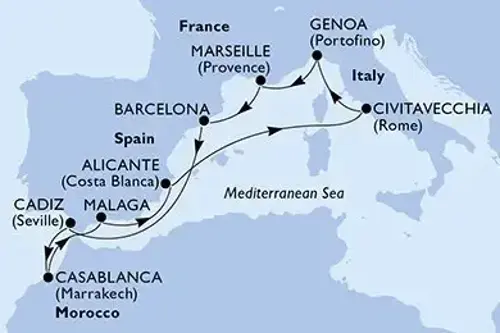
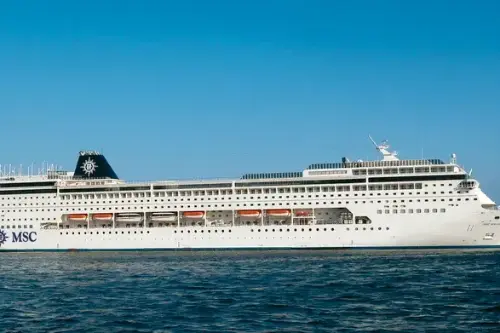
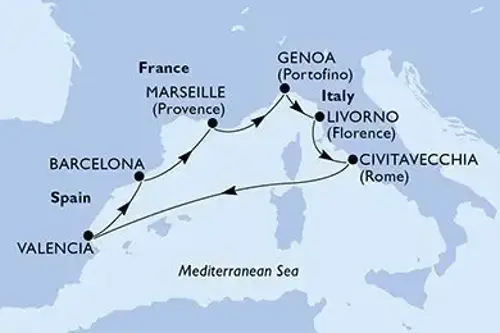
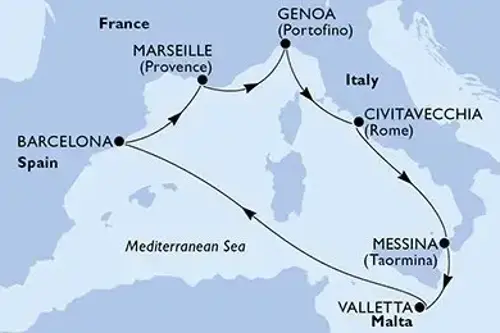
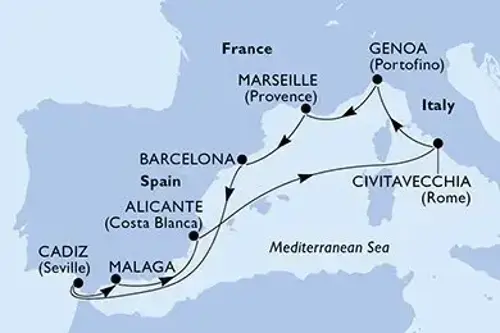
MSC Cruises, Costa Cruises, Royal Caribbean, Norwegian Cruise Line, Celebrity Cruises and other lines sail regularly from Civitavecchia. A typical 7-night itinerary runs Rome (Civitavecchia) → Naples → Sicily or Sardinia → Barcelona → Marseille → Livorno (Florence) → Rome. There are longer 9–14-night programmes taking in Greece, Turkey and other destinations — MSC, for instance, offers a Greek islands itinerary calling at Mykonos, Kuşadası and Marmaris.
Most programmes are round trips Rome → Rome, but Civitavecchia can also be a final port: Royal Caribbean, for example, offers 7-night Rome — Barcelona sailings.
| Port of call | What it offers |
|---|
| Civitavecchia (Rome) | The start and most often the finish of the itinerary |
| Naples | Pompeii, Vesuvius and the Amalfi Coast |
| Palermo (Sicily) | Island Italy: a different cuisine and a different history |
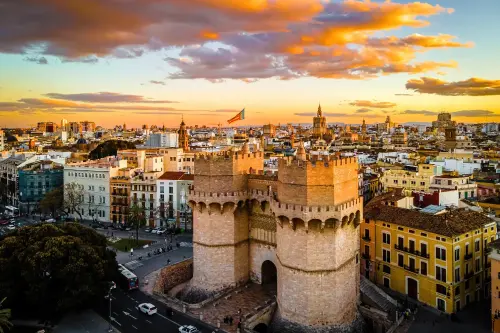
| Barcelona | The other great port of the Western Mediterranean |
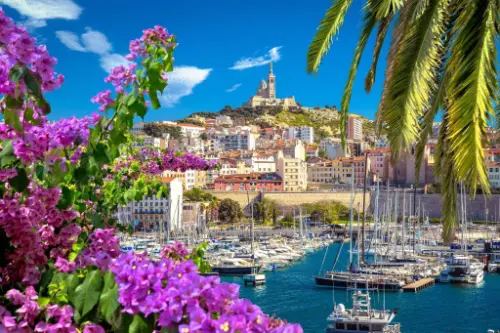
| Marseille | Provence and the south of France |
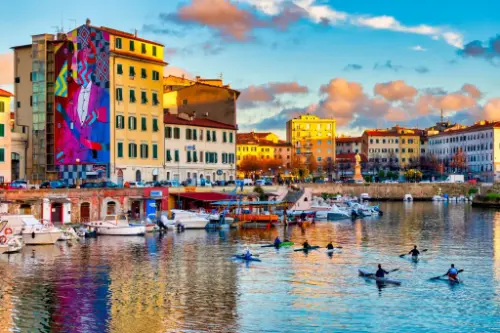
| Livorno | The port for Florence and Pisa |
Why it is a convenient starting point
Civitavecchia is one of the key Mediterranean ports and the main cruise port of Rome, alongside Barcelona. The embarkation port itself is not the most convenient because of the distance to the city, but the destination has two solid advantages: convenient flights, and the fact that Rome as a city costs less than Barcelona. For Western and Eastern Mediterranean itineraries it is a much sought-after embarkation point.
Season and prices
The Mediterranean season from Civitavecchia falls mainly between April and November, although cruises run from this port all year round. Guides for a classic 7-night itinerary:
| Segment | Price guide per person, 7 nights |
|---|
| Budget | around €500–900 |
| Mid-range | around €900–1,500 |
| Premium / luxury | from €1,500 |
The lowest fare in the category at the snapshot date starts from €99, but that is for short programmes rather than week-long ones: the ranges above apply to the classic 7 nights. The price depends heavily on the line, the date, the cabin grade and what the fare includes.
How many nights in Rome beforehand
At least one night before the cruise is essential, and two or three are better. Rome is magnificent and deserves its own time: arriving solely to board the ship means losing half the trip. The optimal formula is two or three days in Rome, then the cruise. It makes more sense to stay in Rome itself rather than in Civitavecchia — provided you have allowed time for the journey to the port on departure day.
Logistics and visas
Visas. Ukrainian citizens do not need a Schengen visa: visa-free travel applies with a biometric passport, 90 days within any 180. Medical insurance with cover from €30,000 is mandatory. Polish citizens need no visa as EU citizens. If the itinerary leaves the Schengen area — with calls in Turkey, for instance — entry conditions should be checked against the specific programme.
The main airport is Rome Fiumicino (FCO), about 70 kilometres from the Civitavecchia cruise terminal. Ciampino (CIA) is also used, particularly by budget airlines, but it is generally less convenient for a cruise. There are direct flights from Chișinău and from Poland almost daily. There are no ready-made hotel-plus-transfer-plus-cruise packages: everyone has their own preference — some stay in a hotel before the cruise, others afterwards.
Conclusion
Civitavecchia is the main sea port of Rome, but it is not Rome itself: 70–80 kilometres and 40–90 minutes by train separate the berth from the Colosseum.
It is nonetheless one of the best starting points for a Mediterranean cruise. The right shape for the trip is simple: come to Rome for two or three days, then set off on the cruise.