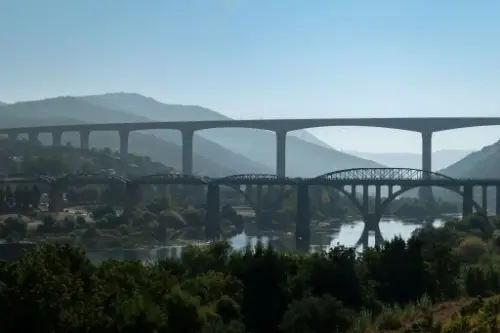
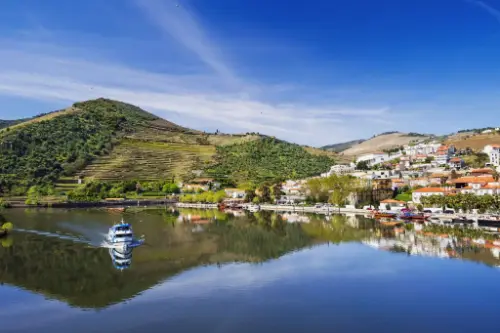
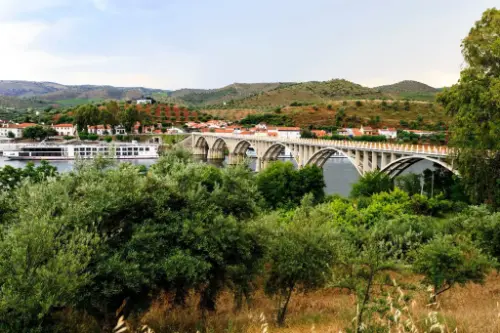
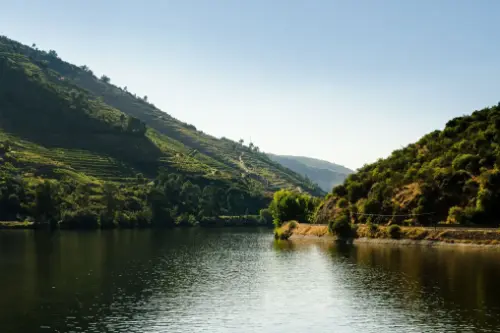
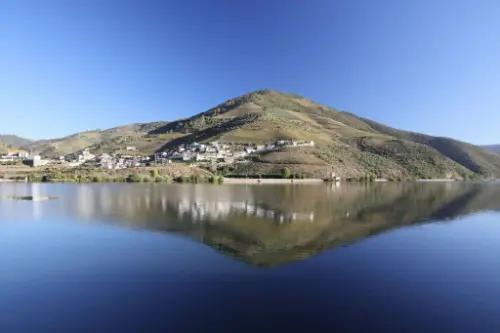
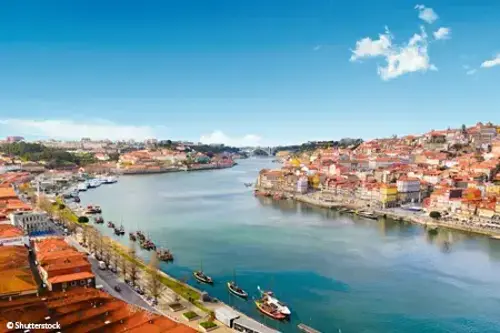
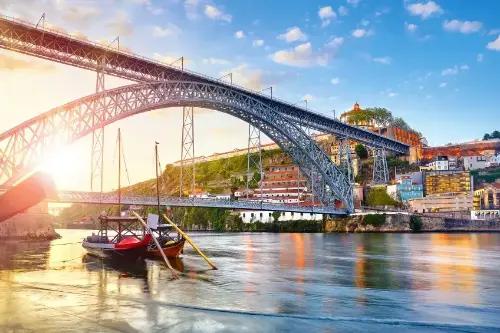
On a Douro cruise the main impression is the valley itself: a narrow river between terraced vineyards inscribed on the UNESCO World Heritage list. You do not hop from city to city here — the ship moves slowly through Portugal’s wine landscape, and the sailing itself becomes the greater part of the journey. The route starts and ends in Porto, and its heart is the valley of port wine.
The route: from Porto into the valley
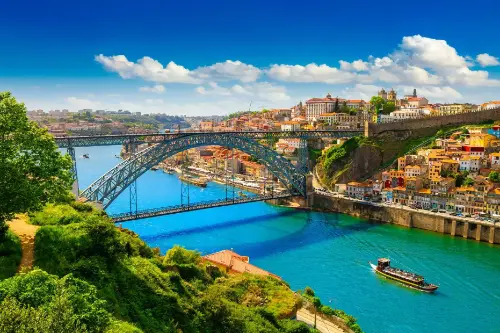
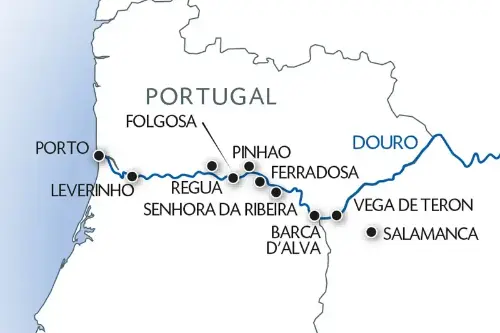
The classic geography is Porto — Régua — Pinhão — Vega de Terrón / Barca d’Alva — Salamanca (an overland excursion) — back to Porto. Specific calls depend on the line: CroisiEurope, for example, sails Porto — Régua — Vega de Terón — Salamanca — Senhora da Ribeira — Leverinho — Porto. The typical format is 7–8 days and 6–7 nights; extended 10–11-day programmes add Lisbon and a land section.
| Port | What it offers |
|---|
| Porto | The start and finish of the programmes; a destination in its own right, worth arriving early for |
| Régua | The gateway to the wine region; Lamego nearby is a classic shore excursion |
| Pinhão | The heart of the terraced vineyards and the quintas — small wine estates |
| Vega de Terrón / Barca d’Alva | The upper point of the route by the Spanish border; the coach to Salamanca leaves from here |
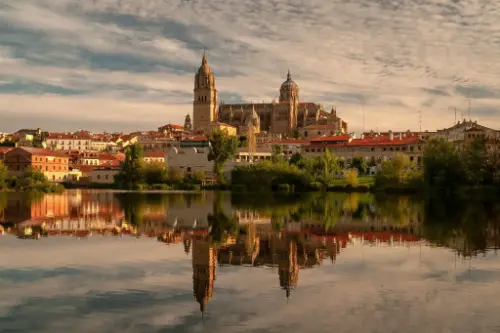
| Salamanca (excursion) | The route’s only major overland outing — a day in Spain |
Small ships: locks and intimacy
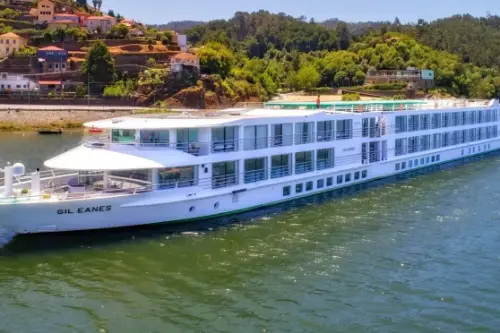
Ships on the Douro are noticeably smaller than typical European river vessels — and this is not just the “boutique” marketing concept but the constraints of the river itself: the locks and the navigation. Most ships carry around 90–130 guests, against 150–190 on classic river vessels. Scenic Azure, purpose-built for the Douro, has 48 cabins and a maximum of 96 guests. Hence the intimate atmosphere on board: the Douro is one of Europe’s most intimate river routes.
Cruise lines and what is included
The Douro is served by CroisiEurope, Uniworld, Scenic, Emerald Cruises and VIVA Cruises. CroisiEurope is one of the most visible operators here: 7-day/6-night Porto — Douro — Salamanca — Porto programmes, with some 2026 itineraries starting from around €1,320. Uniworld holds the luxury segment: the 8-day Douro River Valley Porto–Porto and the extended 11-day Portugal, Spain & Douro River Valley with Lisbon. Scenic and Emerald Cruises offer luxury and premium sailings on small ships, while VIVA Cruises runs classic Porto–Porto programmes.
Compare the fare composition specifically rather than by segment name: meals, drinks, excursions, Wi-Fi, gratuities, transfers, pre- and post-cruise hotels. CroisiEurope includes meals, drinks with meals and at the bar, and Wi-Fi; luxury operators offer wider packages.
The grape harvest: a September chapter
Late August and September bring the grape harvest — a product of its own, not a marketing story. At this time a number of wine estates run special programmes built around the harvest and traditional winemaking. Demand for the Douro is growing and more ships join the river every year — so it is worth booking early.
Salamanca: a day in Spain
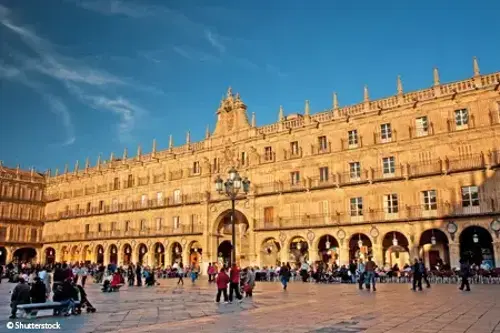
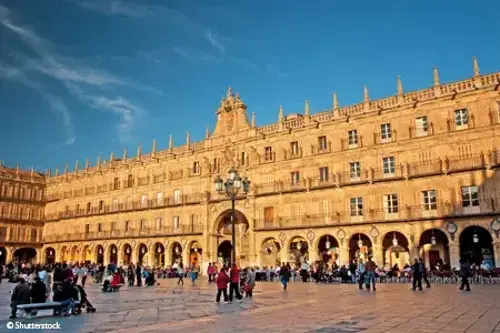
Salamanca is the route’s main international overland outing, but the format matters: it is a coach excursion from a Spanish border port (Vega de Terrón), not a cruise port in its own right. Beyond it, the itineraries offer plenty of shore excursions: wine estates and quintas, Lamego, Peso da Régua, Pinhão, Matosinhos and Porto itself.
Season, duration and prices
The main season runs roughly from April to October.
| Route type | Duration | Price guide per person |
|---|
| Standard / Premium | 6–7 nights | around €1,300–2,500 |
| Luxury | 6–7 nights | around €3,000–5,000+ |
| Extended with Lisbon | 10–11 days | depends on the programme |
The lowest fare on the platform at the snapshot date starts from €728; the table shows indicative segment ranges for the classic duration — the final price depends on the line, fare and date.
Douro or Rhône: choosing a wine cruise
The Douro means vineyards, port wine, Portugal and landscapes: a scenic, intimate cruise where the sailing itself is a large part of the experience. The Rhône means wine plus gastronomy, cities and Provence: more museums, excursions and urban life. Choose the Douro for wine and landscapes, the Rhône for wine, gastronomy and cities. Those drawn to wine and the Atlantic may also look at cruises from Bordeaux — but that is another story.
An honest caveat: the Douro will not suit those expecting big cities, busy day and evening life and metropolitan strolls straight from the berth. And a separate warning for travellers with limited mobility: the valley has many climbs, stairs, uneven streets and steep embankments. The ship itself is comfortable, but the excursions can be physically more demanding than expected.
Logistics and visas
Visas. Ukrainian citizens do not need a Schengen visa: visa-free travel applies with a biometric passport, 90 days within any 180. Medical insurance with cover from €30,000 is mandatory. The Salamanca excursion is Spain — also Schengen, so no separate documents are needed. Polish citizens need no visa as EU citizens.
The most convenient airport is Porto. Ukraine’s airports are closed, so flights are routed through neighbouring countries — usually with a connection at a major European hub or in Istanbul. Plan at least two nights in Porto before the cruise: the city is a destination in its own right, and it would be a shame to fly in only to board the ship. The optimal formula: two nights in Porto → 6–7 nights on the Douro → one or two nights in Porto or the flight home. A strong combination is Lisbon + Douro: Lisbon → Porto → the cruise; Uniworld builds it straight into the product with the 11-day Porto → Lisbon programme.
Conclusion
The Douro is not a cruise between cities. It is a journey through the vineyards of Portugal: Porto, port wine, the terraced valley, small wine estates and a day in Salamanca. The most beautiful way to meet wine-making Portugal — and one of Europe’s most intimate river routes.