What sets Bordeaux apart is that a ship leaves one port for three different waters: the Garonne, the Dordogne and the Gironde estuary. Hence the variety of programmes — itineraries are assembled from different arms of the river, and two cruises “from Bordeaux” may barely share a call. The city itself remains both the point of departure and the point of return.
Three waters, one port
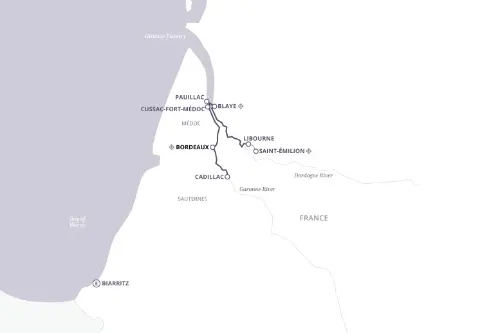
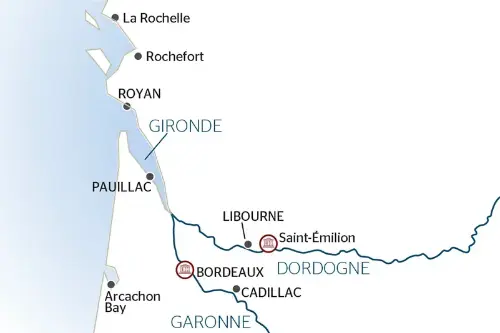
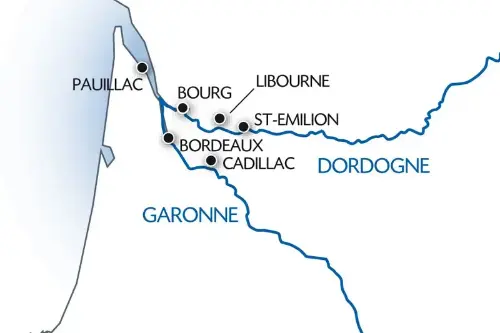
Bordeaux stands on the Garonne, but the cruising here is wider than a single river. The Garonne leads upstream to Cadillac and the vineyards of Sauternes. The Dordogne runs east to Libourne and Saint-Émilion. Further north the two rivers merge into the Gironde estuary — a broad stretch of water with the Médoc on the left bank and Blaye on the right. Uniworld describes its itinerary explicitly as a journey along three waterways: the Garonne, the Dordogne and the Gironde.
| Water | Where it leads |
|---|
| The Garonne | Upstream from Bordeaux: Cadillac and the vineyards of Sauternes |
| The Dordogne | East: Libourne, and from there Saint-Émilion |
| The Gironde estuary | North: the Médoc and Pauillac to the left, Blaye and Bourg to the right |
The classic route and the round trip
Most programmes are round trips: Bordeaux is both the departure and the return port. The broadly classic pattern is Bordeaux → the Gironde and the Médoc → Pauillac or Fort Médoc → Blaye → Bourg → Libourne → Saint-Émilion → Cadillac → Bordeaux. Not every call appears on every cruise, though: one programme leans towards the Médoc and Pauillac, another towards Saint-Émilion and Libourne. Choose a specific programme rather than the departure port alone.
| Place | What it offers |
|---|
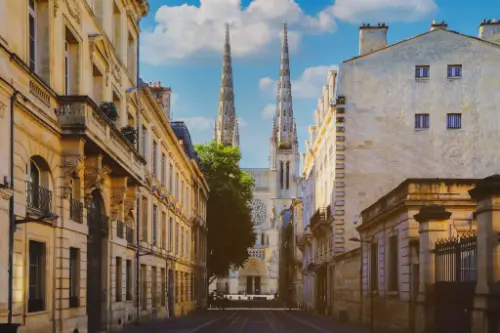
| Bordeaux | Start and finish; a city of 18th-century architecture and the wine capital of the region |
| Pauillac / Fort Médoc | The gateway to the Médoc: the left-bank appellations |
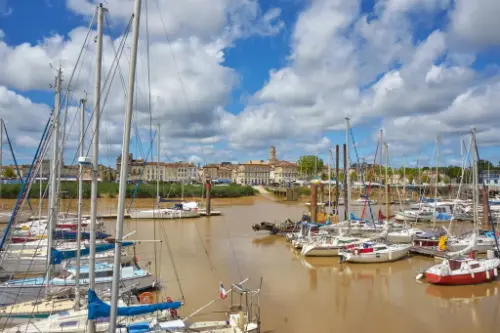
| Blaye | A Vauban citadel above the estuary, on the right bank of the Gironde |
| Bourg | A small town above the river, overlooking the meeting of the Garonne and the Dordogne |
| Libourne | The berth for Saint-Émilion, which lies just a short way inland |
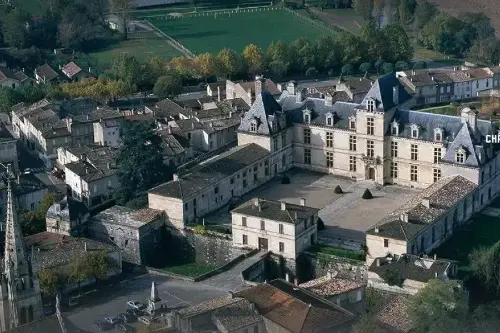
| Saint-Émilion (excursion) | A medieval wine town with a monolithic church carved into the rock |
| Cadillac | The upper point on the Garonne, close to the sweet wines of Sauternes |
Appellations as the substance of the route
Bordeaux is one of the most pronounced wine river cruises: the itinerary runs through the Médoc, Saint-Émilion and Sauternes. Visiting châteaux and tasting the wine is not an optional excursion here but the substance of the trip. That is why the destination works best for travellers with a genuine interest in French wine.
An honest caveat: if wine holds no interest at all, the cruise is still possible — the towns, the citadels and the estuary landscapes remain — but the main value of the route will register more faintly. And another: tastings are not always automatically included in the base fare; it depends on the line and the particular excursion, so check the programme before booking.
Cruise lines and duration
The most characteristic operators are CroisiEurope, Uniworld, Scenic and AmaWaterways. CroisiEurope is one of the mainstays, with short 5-day/4-night programmes and longer itineraries such as Bordeaux → Blaye → Libourne and Saint-Émilion → Bourg → Bordeaux. Uniworld holds the luxury segment with Brilliant Bordeaux — 8 days and 7 nights, Bordeaux → Bordeaux. Scenic sails about 8 nights, calling at Saint-Émilion, Libourne, Blaye, the Médoc and Bourg. AmaWaterways runs wine itineraries along the Garonne and the Dordogne, again out of Bordeaux.
The main formats: 5 days/4 nights through the nearest wine regions, 6 days/5 nights extended, and 7–8 days with 6–7 nights for the fullest itinerary. Luxury lines also offer longer programmes with land extensions.
Tides: why the schedule floats
The Gironde is tidal, and this genuinely affects navigation. CroisiEurope states it plainly: arrival times may shift with the tide, and some calls may be substituted depending on berth availability. This is the normal mechanics of the destination rather than a failure — but it is worth knowing in advance. Depending on the itinerary and the water level, cruises take in Bordeaux, the Médoc and Pauillac, Blaye, Libourne and Saint-Émilion, Cadillac and other wine points; the exact order and timing are confirmed locally.
Season, harvest and prices
The main season runs from April to October. September is of particular interest for the grape harvest: the vineyards are working, and the content of the excursions changes accordingly.
| Programme type | Duration | Price guide per person |
|---|
| Standard programmes | 5–7 nights | around €1,000–1,800 |
| Premium / luxury | 7 nights and more | around €3,000–5,000 and above |
The lowest fare on the platform at the snapshot date starts from €897; the table shows indicative segment ranges, and the final price depends on the line, fare and date. Check separately whether tastings are included in the base fare.
Bordeaux, the Rhône or the Douro
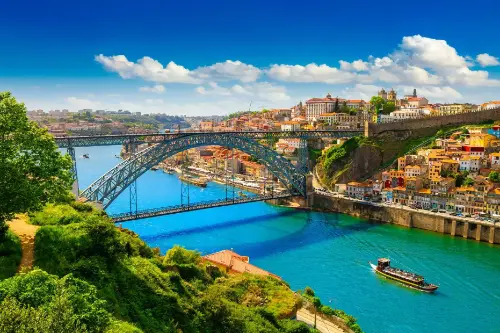
Three wine destinations, three different trips. Bordeaux means French wine and châteaux: the route follows the appellations, tastings make up the substance of the programme, and the water is Atlantic — a broad estuary, tides and citadels. The Rhône means wine plus gastronomy, cities and Provence. The Douro means port wine, terraced vineyards and the landscapes of Portugal, the most intimate of the three. Bordeaux suits those who want not merely to see a wine region but to immerse themselves in the culture of French wine.
Logistics and visas
Visas. Ukrainian citizens do not need a Schengen visa: visa-free travel applies with a biometric passport, 90 days within any 180. Medical insurance with cover from €30,000 is mandatory. Polish citizens need no visa as EU citizens.
The main airport is Bordeaux-Mérignac (BOD). The second workable option is to fly into Paris and continue by TGV: about two hours to Bordeaux. From Chișinău the route runs via Istanbul, from Poland via Paris. Plan one or two nights in Bordeaux before the cruise. The Paris + Bordeaux + cruise combination is an attractive format for a first encounter with France.
Conclusion
Bordeaux is a cruise for those who want not merely to see a wine region but to immerse themselves in the culture of French wine. Châteaux, the Médoc, Saint-Émilion and Sauternes are part of the route itself rather than an appendix to it.
The strongest shape for the trip is Paris → Bordeaux → the wine cruise: the capital, the wine capital and a week across three waters.